
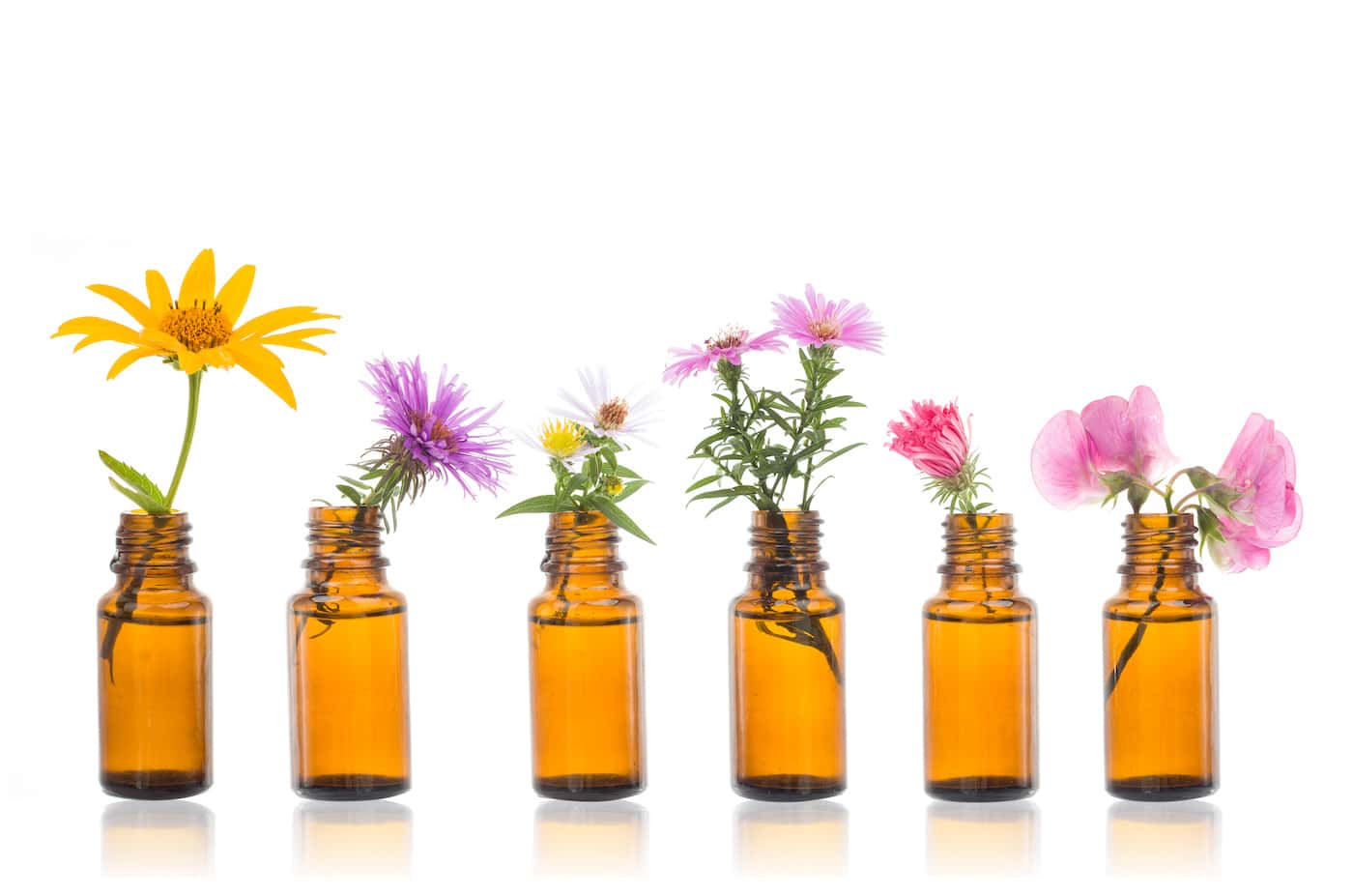
Bach flowers: an overview of their effects, uses and how to take them
Table of contents
Finding the right Bach flower remedy for yourself
List of the 38 Bach flowers and their effects
Agrimony (Agrimonia eupatoria)
Centaury (Centaurium erythraea)
Cerato (Ceratostigma willmottianum)
Cherry Plum (Prunus cerasifera)
Chestnut Bud (Aesculus hippocastanum)
Honeysuckle (Lonicera caprifolium)
Impatiens (Impatiens glandulifera)
Red Chestnut (Aesculus carnea)
Rock Rose (Helianthemum nummularium)
Scleranthus (Scleranthus annuus)
Star of Bethlehem (Ornithogalum umbellatum)
Sweet Chestnut (Castanea sativa)
Water Violet (Hottonia palustris)
White Chestnut (Aesculus hippocastanum)
How do I find the right Bach flowers for my issue?
Which Bach flowers are suitable for which ailments?
How is the information transferred from the plant to the water?
Taking Bach flowers and dosage
Rescue Remedy: a universal first-aid remedy
Bach flowers are a natural remedy based on energetic substances extracted from wildflowers. The plants used are picked in the early hours of the morning and soaked or boiled in spring water that has been exposed to the sun.
Bach flower therapy was founded in the 1930s by the English doctor Edward Bach, who highlighted the links between illnesses and psychological symptoms, which can also indicate future health problems.
Bach flower therapy utilises the benefits of plants in the same way as phytotherapy, homeopathy or herbal medicine, but differs from these in that it aims to restore balance and harmony between body and mind, i.e. it seeks to balance our state of mind, our occasional emotions (anxiety, low spirits, stage fright, etc.) or our chronic emotions (jealousy, irritability, panic, etc.).
The flower essence facilitates inner awareness, self-acceptance and the rediscovery of one’s will and those qualities so often forgotten.
According to Bach, the effectiveness of Bach flowers is based on the similarity – or rather, the correspondence – between the flower and the psychological state of the person concerned: the characteristic of the flower or plant resonates with the person being treated. To see this for yourself, you need only observe the flowers – the connection to the person and their ailments becomes clearly apparent.
“They do not heal by attacking the illness, but by flooding our bodies with the beautiful vibrations of our Higher Nature, in whose presence the illness melts away like snow in the sunshine. There is no true healing unless one’s attitude, peace of mind and inner happiness also change.”
“They cure, not by attacking the disease, but by flooding our bodies with the beautiful vibrations of our Higher Nature, in the presence of which disease melts away like snow in the sunshine. There is no true healing unless there is a change in outlook, peace of mind and inner happiness.”
– Dr Edward Bach, 1934. Howard, J. and Ramsell, J.: The Original Writings of Edward Bach
The effects of Bach flowers
Bach flower therapy is based on the principle that, when caring for a person, the primary focus must be on prevention and an understanding of emotions. It is only when emotions become unbalanced that this leads to greater suffering.
Each Bach flower remedy acts on the imbalanced ‘emotional frequency’ that has caused emotional, psychological or physical discomfort. As we now know, these three spheres are closely interlinked.
Based on these principles, Edward Bach identified 38 behavioural types (37 flowers and water from a spring) that interact with the body through emotions and energy. The flower remedies discovered by Bach impart their ‘energy’ or ‘memory’ to the water. The flowers exert their effect through the memory of the water – through the imprint they bestow upon it through boiling and solarisation.
Bach flower therapy therefore works by addressing the emotional and psychological aspects that trigger or accompany the illness. Treating oneself with Bach flowers does not, therefore, mean working on the symptom or the pathology, but rather on the negative thoughts that cause the disorder. According to Bach, thoughts possess an energy that can negatively influence the organism’s biological functions, causing it to fall ill.
Bach flowers help to restore energy balance and stimulate the self-healing process. The flowers have the power to raise a person’s energy levels and positively transform their mental state. Once this has happened, the effects become visible on a physical level. Bach was convinced that the flowers leave their vibrational imprint in water when it is exposed to the sun.
Bach advocated a simple form of therapy accessible to everyone – anyone could learn to use the flower essences for self-care. The flower essences provide support in the treatment of emotional problems such as anxiety, depression, stress and dissatisfaction, whilst promoting positive emotional states such as calm, happiness and contentment.
Edward Bach
Edward Bach was an English doctor and naturopath. He was born on 24 September 1886 in Moseley, England, and died on 27 November 1936. He studied medicine and worked as a doctor in various hospitals before turning his attention to naturopathy and the search for alternative treatment methods.
Bach advocated the idea that certain flower essences can treat emotional and psychological problems, and developed a method for producing essences from 38 different flowering plants, known as Bach flowers. The use of these essences was intended to help transform negative emotions and behaviours and to promote a positive emotional state.
Towards the end of his life, Bach withdrew from the medical field and devoted himself entirely to the development and promotion of his Bach flower remedy therapy. His work has led to the widespread use of Bach flowers in alternative medicine, and he is regarded as one of the pioneers of the concept that plants have the ability to influence emotional and psychological problems.
Finding the right Bach flower remedy for yourself
If you have a complete set of Bach flowers, you can go through the list every morning and work with the Bach flower that spontaneously catches your eye or triggers a noticeable sensation in your body. This is an incredibly powerful way to tap into your subconscious and begin to understand the needs of your soul.
If you don’t have the relevant essence to hand, you should focus on the corresponding topic throughout the day and keep an eye out for synchronicities that aim to support your healing. Working with Bach flowers on a daily basis is one of the most effective methods for rapid, sustainable and healthy personal development in harmony with the desires and goals of your soul.
If you want to ensure that your choice is made entirely based on your intuition, you can also work intuitively with the Bach flower images and see which flower appeals to you in terms of its shape and aura. This helps you to connect with your intuition and get in touch with what your body, mind and soul need.
When you work with Bach flowers, you can begin to recognise patterns in your life that might be hindering your growth and development. By consciously choosing the Bach flower that resonates with you, you can begin to understand and respond to the needs of your soul.
The following list of Bach flowers is an excellent resource for anyone wishing to learn more about the Bach flower remedy system. It provides an overview of all the Bach flowers, which can be very helpful in understanding the various remedies and their corresponding flower essences.
List of the 38 Bach flowers and their effects
Here you will find a detailed list of the 38 Bach flowers and their general effects:
Agrimony (Agrimonia eupatoria)
For people who hide their problems behind a cheerful façade.
Positive state: openness
Negative states: stress, worries, fears
Indications: stress relief, anxiety management
Aspen (Populus tremula)
for people who are insecure and anxious
Positive state: serenity
Negative states: anxiety, insecurity, nightmares
Indications: overcoming anxiety, support for nightmares
Beech (Fagus sylvatica)
for people who are very critical and intolerant
Positive state: tolerance
Negative states: criticism, intolerance, dissatisfaction
Indications: promoting tolerance, reducing dissatisfaction
Centaury (Centaurium erythraea)
for people who are easily taken advantage of
Positive state: self-confidence
Negative states: subservience, weakness, overwork
Indications: boosting self-confidence, avoiding overwork
Cerato (Ceratostigma willmottianum)
for people who are unsure about their decisions
Positive state: sound judgement
Negative states: insecurity, doubt, feeling overwhelmed
Indications: improving decision-making skills, reducing feelings of being overwhelmed
Cherry Plum (Prunus cerasifera)
For people who are afraid of losing control
Positive state: self-control
Negative states: loss of control, despair, aggression
Indications: strengthening self-control, alleviating despair
Chestnut Bud (Aesculus hippocastanum)
For people who keep making the same mistakes
Positive state: ability to learn
Negative states: repeating mistakes, inability to learn
Indications: improving learning ability, avoiding repeating mistakes
Chicory (Cichorium intybus)
For people who are too focused on the needs of others
Positive state: self-love
Negative states: overprotectiveness, a need for control, jealousy
Indications: promoting self-love, avoiding overprotectiveness
Clematis (Clematis vitalba)
For people who lose themselves too much in dreams and daydreams
Positive state: awareness of reality
Negative states: lethargy, distraction, inattention
Indications: strengthening awareness of reality, overcoming lethargy
Crab Apple (Malus pumila)
For people who feel they are not clean or pure
Positive state: purity
Negative states: obsession with cleanliness, body dysmorphia
Indications: promoting purity, avoiding body dysmorphia
Elm (Ulmus procera)
For people who feel overwhelmed
Positive state: self-confidence
Negative states: feeling overwhelmed, stress, insecurity
Indications: boosting self-confidence, reducing stress
Gentian (Gentiana amarella)
For people who get discouraged easily
Positive state: optimism
Negative states: pessimism, doubt, despair
Indications: promoting optimism, reducing pessimism
Gorse (Ulex europaeus)
For people who are desperate and can no longer find hope
Positive state: hope
Negative states: despair, hopelessness, resignation
Indications: fostering hope, reducing despair
Heather (Calluna vulgaris)
For people who worry too much about the needs of others
Positive state: self-confidence
Negative states: overprotectiveness, loneliness, a need for control
Indications: boosting self-confidence, reducing overprotectiveness
Holly (Ilex aquifolium)
For people who are dominated by resentment and hostility
Positive state: friendliness
Negative states: hostility, resentment, jealousy
Indications: promoting friendliness, reducing hostility
Honeysuckle (Lonicera caprifolium)
For people who live in the past and find it difficult to be in the present
Positive state: grounding in the present
Negative states: nostalgia, homesickness, longing
Indications: grounding in the present, reducing nostalgia
Hornbeam (Carpinus betulus)
For people who feel tired and exhausted, even when they’ve had enough sleep
Positive state: energy
Negative states: tiredness, exhaustion, listlessness
Indications: boosting energy, reducing tiredness
Impatiens (Impatiens glandulifera)
for people who are impatient and nervous
Positive state: patience
Negative states: impatience, nervousness, irritability
Indications: encouraging patience, reducing impatience
Larch (Larix decidua)
For people who lack self-confidence and suffer from self-doubt
Positive state: self-confidence
Negative states: lack of self-confidence, self-doubt, feelings of inferiority
Indications: boosting self-confidence, reducing self-doubt
Mimulus (Mimulus guttatus)
for people who are afraid of familiar things
Positive state: courage
Negative states: anxiety, shyness, nervousness
Indications: boosting courage, reducing anxiety
Mustard (Sinapis arvensis)
For people who experience sudden bouts of depression for no apparent reason
Positive state: joy
Negative states: depression, sadness, melancholy
Indications: promoting joy, reducing depression
Oak (Quercus robur)
For people who push themselves too hard and are unwilling to show weakness
Positive state: serenity
Negative states: overexertion, stubbornness, inflexibility
Indications: promoting a sense of calm, reducing overexertion
Olive (Olea europaea)
For people who are exhausted and drained
Positive state: energy
Negative states: exhaustion, listlessness
Indications: boosting energy, reducing exhaustion
Pine (Pinus sylvestris)
For people who feel guilty and inadequate
Positive state: self-confidence
Negative states: feelings of guilt, low self-esteem, feelings of inferiority
Indications: boosting self-confidence, reducing feelings of guilt
Red Chestnut (Aesculus carnea)
For people who are worried about others and fear that something might happen to their loved ones
Positive state: serenity
Negative states: excessive worry, anxiety, nervousness
Indications: promoting a sense of calm, reducing excessive worry
Rock Rose (Helianthemum nummularium)
for people who find themselves in an exceptional situation
Positive state: confidence
Negative states: panic, severe anxiety
Indications: building confidence, finding calm during panic attacks
Rock Water (Aqua salvationis)
for people who are rigid in their thinking
Positive state: mental agility
Negative states: mental inflexibility, rigidity
Indications: encouraging openness
Scleranthus (Scleranthus annuus)
For people who find it difficult to make decisions
Positive state: determination
Negative states: indecision, fickleness
Indications: support with decision-making
Star of Bethlehem (Ornithogalum umbellatum)
for people who are grieving
Positive state: confidence
Negative states: grief, sorrow
Indications: coping with grief, fostering optimism
Sweet Chestnut (Castanea sativa)
For people who are feeling discouraged and physically exhausted
Positive state: courage
Negative states: feelings of despair, despondency
Indications: promoting confidence
Vervain (Verbena officinalis)
For people who are easily agitated and convinced that their opinion is the only correct one
Positive state: tolerance
Negative states: conviction, fanaticism, dogmatism
Indications: promoting tolerance, reducing conviction
Vine (Vitis vinifera)
For people who are dominant and want to control others
Positive state: flexibility
Negative states: dominance, control, dictatorial behaviour
Indications: promoting flexibility, reducing dominance
Walnut (Juglans regia)
For people who are going through a period of transition or who are finding it difficult to adapt to change
Positive state: adaptability
Negative states: lack of flexibility, difficulty adapting to change
Indications: promoting adaptability, promoting flexibility
Water Violet (Hottonia palustris)
for people who are independent and like to keep to themselves
Positive state: friendliness
Negative states: isolation, loneliness, independence
Indications: promoting friendliness, reducing isolation
White Chestnut (Aesculus hippocastanum)
For people who constantly have thoughts and worries running through their minds
Positive state: calm
Negative states: ruminating, worries, restlessness
Indications: promoting calm, reducing racing thoughts
Wild Oat (Bromus ramosus)
For people who are unsure which path in life to take
Positive state: clarity
Negative states: insecurity, doubt, disorientation
Indications: promoting clarity, reducing uncertainty
Wild Rose (Rosa canina)
for people who feel resigned and apathetic
Positive state: enthusiasm
Negative states: resignation, apathy, indifference
Indications: fostering enthusiasm, reducing resignation
Willow (Salix vitellina)
For people who feel they have been treated unfairly
Positive state: acceptance
Negative states: dissatisfaction, feelings of injustice, self-pity
Indications: promoting acceptance, reducing dissatisfaction
How do I find the right Bach flowers for my issue?
To find the right Bach flowers for a specific life issue or a current problem, I recommend consulting a therapist or Bach flower remedy counsellor with the appropriate qualifications and experience. Following a personal consultation, during which the person’s feelings, behaviours and challenges are discussed, a recommendation can be made.
It is also possible to carry out a Bach flower remedy test yourself, but it is important to note that these tests are for guidance only and are no substitute for individual counselling. It is essential to seek professional advice before starting to take Bach flowers.
How are Bach flowers made?
There are two main methods for producing Bach flowers:
the traditional method and the Stockbottle method.
Here is a brief overview of both approaches:
Traditional method
This is the original method developed by Dr Edward Bach. The following provides an overview of the individual steps involved in producing Bach flower essences:
- Harvesting: The plants are harvested at specific times of the day and year, namely when their energy is at its strongest.
- Preparation: The harvested plants are washed, cut and laid out in a glass or stainless steel container.
- Infusion: A specific quantity of pure spring water is poured over the plants and then slowly heated to release the energetic patterns.
- Steeping: The infusion is left to stand in a warm, sunny place to energise the water.
- Filtering: The plant residues are filtered out of the infusion and the remaining water is bottled and preserved.
- Dilution: The preserved water is diluted with alcohol and water to ensure a longer shelf life.
Stockbottle method
The Stockbottle method is a modern production technique that speeds up the process. It involves using a single bottle, known as a stock bottle, to capture the plant’s energetic pattern. The contents of the stock bottle are diluted and used to prepare further essences.
Both methods have their advantages and disadvantages, but can lead to a high-quality end product if carried out correctly. However, it is important to ensure that only high-quality, natural ingredients are used to guarantee the effectiveness and quality of the Bach flowers.
Which Bach flowers are suitable for which ailments?
If you want to know which Bach flower remedy is suitable for which physical and emotional ailments, I can help you with this list of Bach flowers for specific physical and emotional problems:
- Stress and anxiety: Rock Rose, Aspen, Cherry Plum, Impatiens, Clematis, Star of Bethlehem
- Depression and sadness: Hornbeam, Wild Rose, Clematis, Sweet Chestnut, Star of Bethlehem, Olive
- Insomnia: White Chestnut, Rock Rose, Clematis, Aspen, Star of Bethlehem
- Nervousness and restlessness: Cherry Plum, Rock Rose, Impatiens, Star of Bethlehem, Clematis
- Lack of self-confidence and self-esteem: Chicory, Larch, Wild Oat, Hornbeam, Chestnut Bud
- Fears and phobias: Rock Rose, Cherry Plum, Aspen, Star of Bethlehem, Red Chestnut
- Pain and illness: Rescue Remedy, Crab Apple, Elm, Oak, Holly
- Trauma and stress: Rock Rose, Cherry Plum, Star of Bethlehem, Clematis, Impatiens
- Relationship problems: Holly, Vine, Beech, Cherry Plum, Impatiens
- Conflicts and communication problems: Beech, Impatiens, Larch, Holly, Vine
- Loneliness and isolation: Gentian, Hornbeam, Clematis, Wild Oat, Olive
- Indecision and lack of direction: Cerato, Scleranthus, Wild Oat, Gorse
- Dissatisfaction and resignation: Sweet Chestnut, Pine, Elm, Willow
- Overload and burnout: Elm, White Chestnut, Clematis, Star of Bethlehem
- Physical ailments: Rescue Remedy, Crab Apple.
It is important to note that every person is unique and may require different Bach flowers to address the same issue. It is recommended that you consult a certified Bach flower remedy practitioner to ensure you make the right choice.
How is the information transferred from the plant to the water?
In Bach flower therapy, it is believed that the plant’s energetic pattern or vibration is transferred to the water. This occurs by soaking the flowers or buds in water during the production of Bach flower essences. The idea is that the water absorbs and stores these vibrations, thereby providing the plant’s therapeutic effect.
It is important to note, however, that this transfer of vibrations is a speculative idea and has not been scientifically proven. To date, there have been no scientific studies that have been able to demonstrate the transfer of vibrations from plants to water or other substances. The effectiveness of Bach flowers is, however, confirmed by many users.
Taking Bach flowers and dosage
Bach flowers are not usually taken individually, but in combination with one another. To dilute the Bach flowers, you can add two drops of the chosen Bach flower to a glass of water. Then drink this glass of water throughout the day.
For long-term use, you can also prepare a Bach flower remedy mixture in a dropper bottle. To do this, simply add three drops of each chosen flower to a 30-ml bottle and dilute with still mineral water. To improve the shelf life, you can also add a little alcohol.
How often you should take the Bach flowers depends on the problem you wish to treat. However, it is recommended that you take at least four drops four times a day. In acute situations, such as a panic attack, it may be necessary to take the Bach flowers more frequently – for example, four drops every 2 to 3 minutes. As a general rule, adults require 6 to 8 Bach flowers daily. It is repetition, rather than quantity, that is crucial to the effectiveness of Bach flower therapy.
One extra dose a day is better than one less, and it is repetition that increases the effectiveness. The standard dosage is four times four drops a day, but both the number of drops and the frequency of administration can be adjusted as required. Thanks to the gentle nature of Bach flowers, it is not possible to overdose.
Here is an overview of the recommended dosages:
- Acute situations: add two drops of each flower essence to a glass of water and drink throughout the day.
- Long-term use: add three drops of each flower essence to a 30-ml dropper bottle and dilute with still mineral water. Optionally, you can add a little alcohol to improve shelf life.
- Standard dosage: take four drops four times a day.
- Frequency: depends on the problem you are treating. Take at least four times a day. In acute situations, such as a panic attack, you may need to take it more frequently (four drops every 2 to 3 minutes).
- Quantity: Adults generally require 6 to 8 Bach flowers daily.
- Effectiveness: An extra dose per day is more effective than one less, and it is the repetition that increases the effectiveness.
- Overdose: Not possible due to the gentle nature of the remedy.
Bach flowers and children
Bach flowers can also be used on children. The treatment is completely natural, safe and produces excellent results. As a child’s psychological structures offer less resistance to the effects of the flowers, the results are often incredibly rapid and long-lasting.
As with adults, you must also take the child’s personality into account to identify the difficulties they are facing. You must also understand their typical reactions in order to administer the flowers correctly. The dosage is the same as for adults (4 drops as often as necessary, but at least four times a day), whilst infants can have the remedy diluted in milk, juice or baby food. For breastfed infants, it is sufficient for the baby to take the remedy.
According to Bach, even the youngest children benefit most from Bach flowers, and they are generally used to help with difficulties at school, restlessness and agitation, or for very shy and reserved children to help them open up to others.
Bach flowers and animals
Bach flowers are also used on pets, and they often work even better on them than on humans. Bach flowers can be administered to pets in various ways to improve their emotional wellbeing. The most common method is to administer 2–4 drops directly into the animal’s mouth.
If this proves difficult, the drops can also be drawn up into a syringe without a needle along with a little water and sprayed directly into the mouth to avoid being bitten. Another option is to moisten the animal’s nose, ears, lips or the palm of its paw, so that it can absorb the remedy by licking it or through direct absorption via the skin.
For larger animals such as horses, pigs and cattle, the dosage should be increased to 10 drops per bucket of water. It is important to choose the method that makes it easiest for the animal to take the correct dose. Exotic animals, such as chameleons, are best treated by moistening their enclosure with a spray bottle, from which they will then drink spontaneously. For birds, add a few drops to their drinking water; for fish, add it directly to the aquarium.
If you wish to use Bach flowers on animals, you must analyse the animal’s characteristics and personality in detail in order to select the appropriate flowers. For example, Heather can be used for dogs that bark a lot, whilst Chicory is used for four-legged friends who are afraid of being abandoned. Nervous or anxious dogs and cats can be calmed with Mimulus.
The dosage at a glance:
- 2–4 drops directly into the mouth
- Draw up with water using a syringe without a needle
- Moisten the nose, ears, lips or the palm of the paw
- 10 drops per bucket of water for larger animals
- It is best to choose a simple method for the animal
- Exotic animals are best placed in a spray bottle
- For birds, add a few drops to their drinking water
- For fish, add directly to the aquarium.
Bach flowers for plants
If plants are having problems, you can help them with Bach flowers. After repotting, for example, you can support them with Rescue Remedy and Walnut. There are also other Bach flowers that can be used for specific problems. For example, you can use Crab Apple in combination with Rescue Remedy to ward off pests. Or Hornbeam, Olive and/or Gorse if the plant is weakened, to help it regain its strength and vigour.
But actually, you can use any Bach flower remedy to treat plants, as long as you recognise in it the equivalent of the condition for which you administer the same remedies to people.
Rescue Remedy: a universal first-aid remedy
Rescue Remedy is a universal first-aid remedy designed to provide relief in moments of distress and emergency. It is a blend of five Bach flowers selected by Dr Edward Bach to provide rapid and effective calming relief. It can help to reduce anxiety and panic, keep a cool head in times of anger and agitation, alleviate exam anxiety or air travel anxiety, and help you find calm and composure in difficult situations.
Dr Edward Bach, the father of flower therapy, created the remedy to provide a simple and effective method for treating a wide range of ailments and conditions. It is a natural, non-addictive remedy that works immediately and, in times of crisis, provides us with the tools we need to stay in control and make the best possible decisions.
Rescue Remedy is a powerful ally in difficult situations, as it brings out the inner strength needed to face life’s challenges with courage and composure. It is important to observe how the flowers behave in their environment in order to truly understand the remedy’s power.
Many of the flowers used in Rescue Remedy are known for thriving in difficult conditions and being resistant to disease. These characteristics show that the remedy can help people to survive even under difficult conditions and to find their inner strength.
I would like to emphasise that Rescue Remedy is based exclusively on flower essences and that none of these remedies can be described as a medicine or a herbal medicinal product.
The effect of these remedies is not based on synthetic chemical or plant-based ingredients, but on the specific vibrational patterns that occur naturally in the flowers and plant parts and are intended to be transferred to the essences during production. It is worth noting that these remedies are well tolerated by children and are therefore ideal for use with them.
Bach flower Rescue Remedy is a natural and safe way to promote calm and balance in stressful situations.
There are three ways to use the remedy: orally, directly under the tongue and topically.
Oral: Add 4 drops of the remedy to a handful of water and drink slowly.
Directly under the tongue: 4 drops of the undiluted remedy are allowed to dissolve directly under the tongue and are absorbed by the body.
Topical: A cream version of the product is available for use on skin conditions such as eczema, psoriasis, rashes and burns. The cream is applied lightly and evenly to the affected area and can be used several times a day as required to relieve symptoms.
Bach flower Rescue Remedy is an effective and safe way to help with physical and emotional stressors. It is a natural alternative that, when used immediately, delivers fast and effective results.
In summary, it can be said that Bach flowers may be an interesting alternative for those seeking a gentle solution to emotional stress and mental states. However, it is important to note that there is no scientific evidence to support their effectiveness.
I would like to thank you from the bottom of my heart for taking the time to read this article.
If you have any further questions or would like to share your own thoughts, I’d be delighted if you could leave a comment. And if you think this article might be helpful to others, please feel free to share it.
Leave a Reply